
Interventional Spine Care in Bend, Oregon
Back pain, neck pain, and radiating nerve pain affect how you move, work, and live. When conservative care — rest, physical therapy, over-the-counter medications — hasn't provided lasting relief, an evaluation with an interventional spine physician is a reasonable next step.
At High Desert Sports & Spine, our fellowship-trained and board-certified physicians specialize in interventional spine care in Bend, Oregon. We focus on minimally invasive approaches to spine pain; targeted treatments designed to identify and address the source of your symptoms without traditional open surgery.
Whether you’re dealing with chronic back pain, a herniated disc, sciatica, or facet joint degeneration, we start with a thorough evaluation, give you a clear picture of what’s contributing to your pain, and walk you through the options that are appropriate for your specific situation.



Spine Conditions We Commonly Treat
Interventional spine care is appropriate for a wide range of conditions. Our physicians commonly evaluate and treat:
- Low back pain — the most common spine complaint, often arising from disc degeneration, facet joint arthritis, muscle weakness, or strain
- Herniated or bulging disc — when disc material presses on nearby nerves, causing radiating pain into the arms or legs
- Sciatica — radiating pain, numbness, or weakness traveling from the lower back through the buttock and down the leg, typically caused by nerve compression
- Spinal stenosis — narrowing of the spinal canal that can compress nerves, causing leg pain, cramping, or weakness with standing and walking
- Degenerative disc disease — gradual wear of the discs between vertebrae, leading to pain when sitting, stiffness, and reduced mobility
- Facet joint arthropathy — arthritis of the small joints that connect vertebrae, a common cause of chronic neck and back pain
- Sacroiliac joint dysfunction — pain originating from the joints that connect the spine to the pelvis, often felt in the lower back, buttock, or hip
- Neck pain and cervical radiculopathy — nerve compression in the neck causing pain, tingling, or weakness radiating into the arms and hands
- Vertebral compression fractures — spinal fractures most commonly caused by osteoporosis, causing sudden severe back pain
- Post-surgical spine pain — persistent or recurrent pain following prior spine surgery
If you’re unsure whether your condition is appropriate for interventional spine care, our team can help you determine the right next step. Many patients who come to us have already tried other procedures, surgeries, or approaches without full resolution — that’s exactly the population we serve.
Interventional Spine Procedures at High Desert Sports & Spine
We use a range of interventional procedures to treat spine pain. Each is selected based on your specific diagnosis and treatment goals, not applied as a one-size approach.
Here is an overview of procedures available at our Bend, OR clinic:
Epidural Steroid Injections
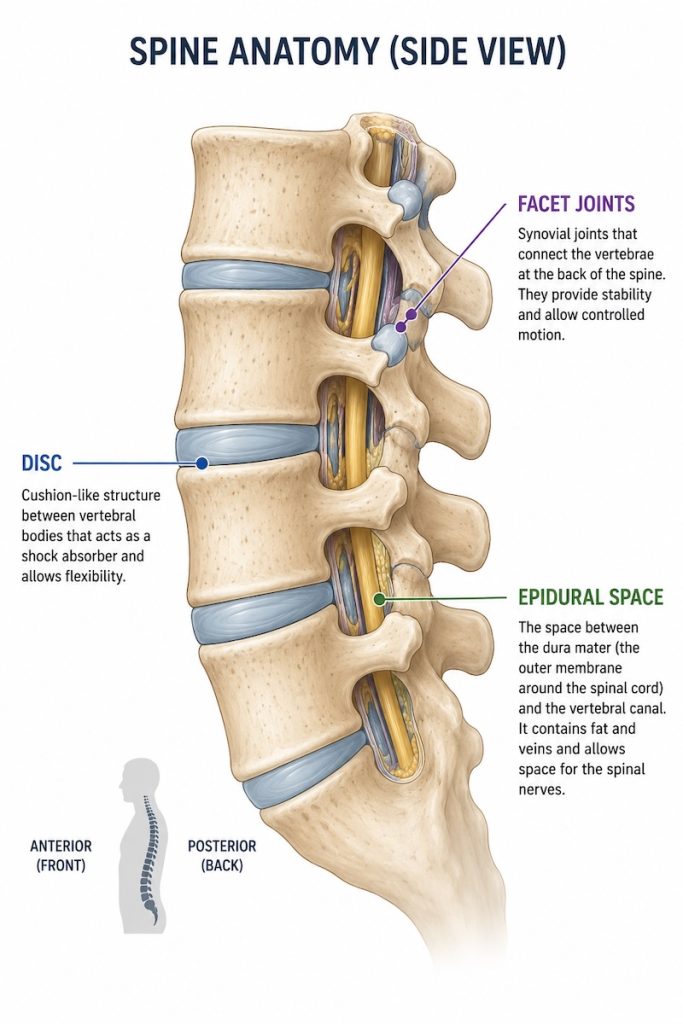
An epidural steroid injection (ESI) delivers a corticosteroid medication directly into the epidural space around the spinal nerve roots. The injection reduces inflammation at the nerve, which can provide meaningful relief from radiating pain caused by disc herniation, spinal stenosis, or nerve compression. ESIs are performed under fluoroscopic guidance and are commonly used for cervical, thoracic, and lumbar radiculopathy.
Facet Joint Injections
Facet joints connect vertebrae along the spine and can become arthritic over time. A facet joint injection delivers a local anesthetic with or without a corticosteroid directly into the affected joint. These injections serve both diagnostic and therapeutic purposes, confirming the joint as the source of the pain while providing relief.
Medial Branch Blocks
Medial branch nerves supply sensation to facet joints. A medial branch block (MBB) is a diagnostic injection that numbs these nerves to confirm that the facet joint is the source of pain. If two medial branch blocks provide significant relief, the patient may be a candidate for radiofrequency ablation to achieve longer-lasting results.
Radiofrequency Ablation (RFA)
Radiofrequency ablation uses heat generated by radiofrequency energy to disrupt the medial branch nerves that carry pain signals from arthritic facet joints to the brain. RFA can provide longer-lasting relief than injections alone, typically six months to over a year, and is a well-established intervention for chronic spine pain.
Sacroiliac Joint Injections
The sacroiliac (SI) joints connect the spine to the pelvis and are a common but often overlooked source of low back and buttock pain. SI joint injections deliver anesthetic and corticosteroid medication directly into the joint under imaging guidance.
Nerve Blocks
Nerve blocks deliver anesthetic medication to specific nerves or nerve groups to interrupt pain signals. They are used for both diagnostic purposes (confirming that a nerve is the source of the pain) and therapeutic relief.
Kyphoplasty
Kyphoplasty is a minimally invasive procedure for vertebral compression fractures, most commonly caused by osteoporosis. A small balloon is inserted into the fractured vertebra to restore height, and then bone cement is injected to stabilize the fracture. The procedure is performed on an outpatient basis and can provide rapid pain relief.



What to Expect at Your Interventional Spine Appointment in Bend, OR
Your first visit is an evaluation — not a procedure. Here’s how the process typically works:
- Specialty evaluation. We review your medical history, symptoms, prior imaging, and any previous treatments. This is a thorough, physician-directed assessment — not a rushed intake.
- Diagnosis and discussion. You’ll leave understanding what’s contributing to your pain, what options may be appropriate, and what realistic expectations look like for each.
- Imaging review. If you have prior MRI, CT, or X-ray studies, bring them. If imaging is needed and hasn’t been done yet, we can help coordinate it.
- Procedure scheduling. If an interventional procedure is recommended, we’ll schedule it as a separate appointment in most cases. You’ll receive clear instructions on preparation.
- Procedure. Most interventional spine procedures are performed in the office, take 15 to 45 minutes, and require no general anesthesia.
- Post-procedure guidance and follow-up. We’ll provide specific instructions on activity, what to expect as the treatment takes effect, and when to follow up to assess your response.
Our goal throughout is clarity. You’ll understand what was done, why it was done, and what comes next — without pressure to proceed with any treatment you’re not ready for.
Why Choose High Desert Sports & Spine for Interventional Spine Care in Bend?
For patients in Central Oregon looking for minimally invasive spine care, a few things set our approach apart.
Fellowship-Trained, Board-Certified Physicians
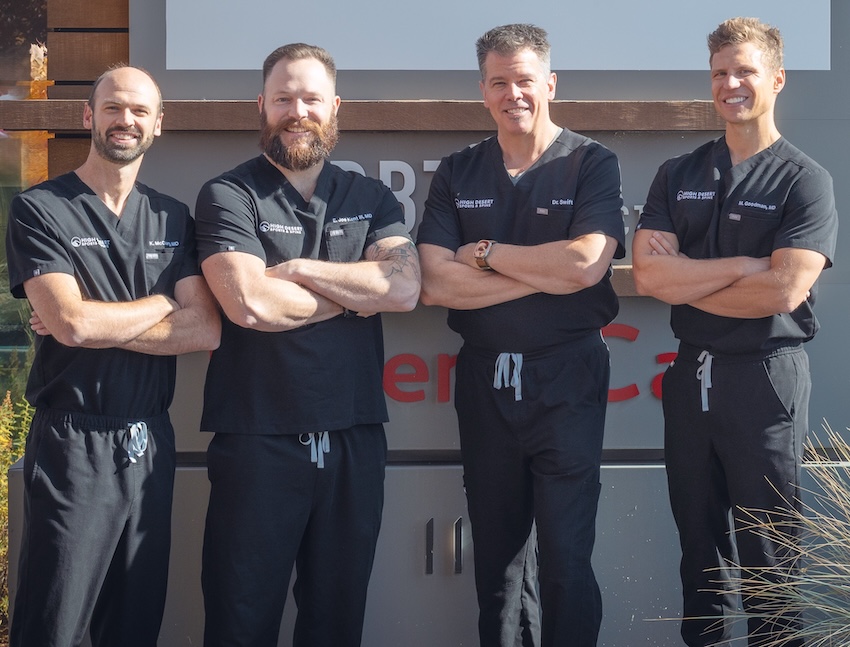
Our interventional spine physicians are fellowship-trained and board-certified MDs. That level of training matters when it comes to accurately diagnosing spine pain, selecting the right procedure, and performing it with precision. Fellowship training in interventional spine is specific and rigorous — it is not a credential every provider in this space holds.
Imaging-Guided Procedures
Every interventional spine procedure we perform uses fluoroscopic or ultrasound imaging guidance. Real-time imaging confirms the target structure, guides needle placement, and ensures accurate delivery of the treatment. Procedures without imaging guidance are less precise. At HDSS, imaging guidance is standard.
Minimally-Invasive Focus
Our practice is built around minimally invasive interventional care. We are not a surgery-first environment. We are not a medication management practice. Our goal is to find the most appropriate option for your condition and deliver it well. When traditional spine surgery is the right call, we will tell you — and coordinate a clear referral.
Timely Access
New patient evaluations are available within the same week in most cases. For patients dealing with acute or worsening spine symptoms, waiting months to see a specialist is not acceptable care. We built HDSS around faster access to physician-level evaluation.
We serve patients throughout Central Oregon, including Bend, Redmond, Sisters, Prineville, La Pine, and Sunriver, from our convenient Bend, OR, location.



Interventional Spine Care in Bend, Oregon — Start With an Evaluation
If back pain, neck pain, or nerve-related symptoms are limiting your daily life, an evaluation with a fellowship-trained interventional spine physician is the next step.
At High Desert Sports & Spine, we start with a thorough assessment, give you honest answers about what’s contributing to your symptoms, and walk you through the options that make sense for your specific situation, without pressure.
Same-week appointments are available for new patients. We serve Bend, Redmond, Sisters, Prineville, La Pine, Sunriver, and patients throughout Central Oregon.
Frequently Asked Questions About Interventional Spine Care in Bend, Oregon
Interventional spine care is a medical specialty focused on diagnosing and treating spine-related pain using targeted, minimally invasive procedures or surgery — injections, nerve blocks, and ablations — rather than large open surgeries or long-term medications. The goal is to identify the structural source of pain and address it directly with precision, while minimizing damage to surrounding structures.
Traditional spine surgery involves physical alteration of spinal structures, necessitating large incisions and resulting in damage to surrounding structures — this involves removing disc material, fusing vertebrae, or decompressing nerves. Interventional spine procedures work differently. They deliver targeted therapy using image guidance to specific nerves or joints to reduce pain without opening the spine. They are outpatient procedures that require no general anesthesia in most cases and involve minimal recovery time. They are appropriate for a different set of conditions and typically serve as an alternative to traditional surgery.
The two overlap, but they are not the same. Traditional pain management often involves medications — including opioids — to manage chronic pain symptoms. Interventional spine care focuses on procedure-based treatments that target the structural source of spine pain. At HDSS, our approach is interventional. We do not prescribe or manage opioid pain medications.
Interventional spine care is appropriate for many spine-related conditions, including herniated or bulging discs, sciatica, spinal stenosis, degenerative disc disease, facet joint arthritis, sacroiliac joint pain, vertebral compression fractures, and chronic neck or back pain. Not every condition is a good fit for every procedure — an evaluation is the right starting point.
No referral is required. You can contact our office directly to schedule an evaluation. If you have prior imaging or notes from another provider, bringing those to your first appointment is helpful.
Duration varies by individual and by condition. Some patients experience relief for several weeks; others for several months. ESIs are not a permanent solution — they reduce inflammation around the nerve and provide a window for recovery and rehabilitation. Your physician will discuss realistic expectations based on your specific situation.
Facet radiofrequency ablation (RFA) uses heat to disrupt the nerves that carry pain signals from arthritic facet joints. The effect typically lasts six to eighteen months. Because RFA requires prior diagnostic confirmation via medial branch blocks, it involves a multi-step process before the ablation itself is performed. Your physician will explain whether you are a candidate based on your evaluation.
Most interventional spine procedures involve minimal activity restriction. Specific guidance depends on the procedure and the area treated. Your physician will give you clear post-procedure instructions. Most patients return to light activity the same day or the following day.
Yes, in some cases. Patients with persistent or recurrent pain following prior spine surgery — sometimes called post-laminectomy syndrome or failed back surgery syndrome — may benefit from interventional procedures. A thorough evaluation, including review of prior operative notes and imaging, helps determine what options may be appropriate.
Many interventional spine procedures — including epidural steroid injections, facet joint injections, medial branch blocks, and radiofrequency ablation — are covered by most major insurance plans when medically necessary criteria are met. Coverage varies by payer, plan, and specific procedure. Our team can assist with insurance verification and help you understand your benefits before scheduling a procedure.