Shockwave Therapy in Bend, Oregon
Shockwave Therapy (ESWT) is an interventional orthopedic therapy that works by targeting sonic energy to relieve pain and promote healing in damaged tissue.
Shockwave therapy is a non-invasive, office-based treatment that uses acoustic energy to stimulate healing in damaged tendons, soft tissue, and bone. At High Desert Sports & Spine, it’s one of several interventional tools our fellowship-trained, board-certified physicians use to address chronic orthopedic conditions that haven’t responded to standard conservative care.
We offer both focused shockwave therapy (ESWT) and radial shockwave therapy (EPAT) — two distinct modalities that work differently and are used for different clinical situations. Your physician will determine which approach, or combination of approaches, is appropriate based on your condition, the tissue involved, and the depth of the target.
If you’ve been dealing with a stubborn tendon injury, chronic heel pain, or a condition that keeps flaring despite rest and physical therapy, shockwave may be worth discussing. The right starting point is a thorough evaluation — not a treatment. We’ll tell you whether it makes sense for your situation, and what to expect if it does.



What Is Shockwave Therapy?
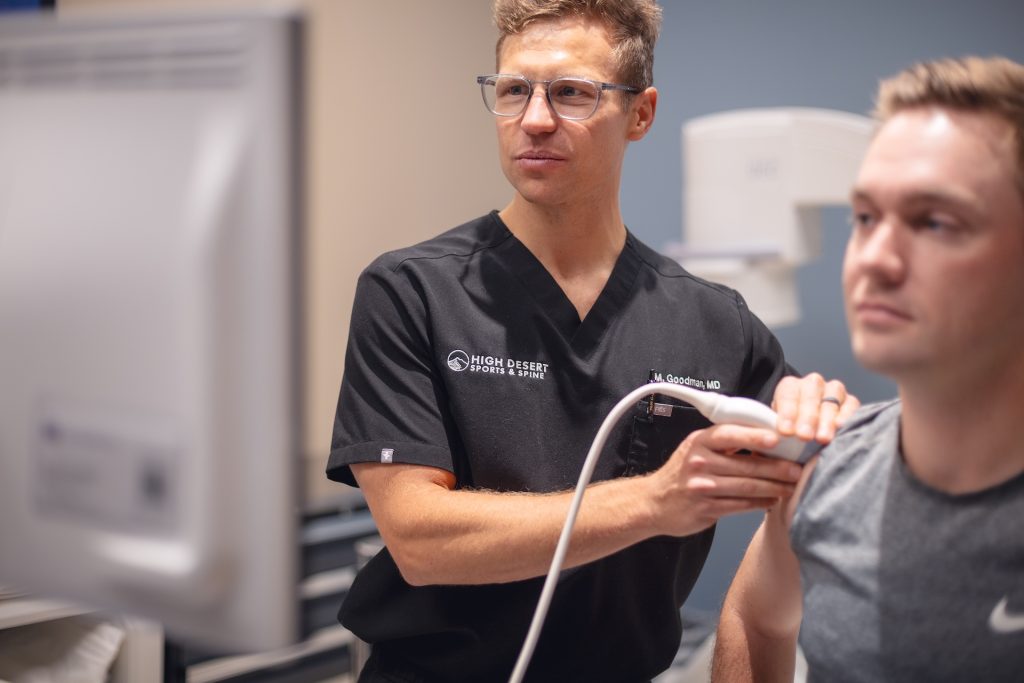
Shockwave therapy delivers controlled acoustic waves — sound energy — to a targeted area of damaged or degenerated tissue. These waves create a mechanical stimulus at the cellular level that can trigger a healing response in tissue that has stalled or struggled to recover on its own.
The treatment works in several ways: it can break down calcific deposits, stimulate new blood vessel formation, interrupt pain signals in affected nerves, and activate the body’s natural tissue repair mechanisms. The result is that chronically inflamed or poorly vascularized tissue — the kind that doesn’t heal well without intervention — gets a biological nudge toward recovery.
HDSS offers two forms of shockwave therapy:
Focused Shockwave Therapy (ESWT)
Focused shockwave generates high-energy acoustic waves that converge at a specific depth within the tissue. This is considered true shockwave therapy and is well-suited for conditions involving deeper structures — tendons at their bony insertion, bone stress injuries, and calcific deposits. It’s more precise and can treat targets that radial pressure waves can’t reach effectively.
Radial Shockwave Therapy (EPAT — Extracorporeal Pulse Activation Technology)
Radial shockwave generates pressure waves that spread outward from the applicator, covering a broader surface area at lower energy. It’s better suited for more superficial tissue — muscle bellies, myofascial trigger points, and the body of tendons rather than their insertions. EPAT is often used alongside ESWT for conditions that benefit from treating multiple tissue depths.
In practice, a combination of focused and radial shockwave is often the most effective approach. Your physician will determine what’s appropriate based on your diagnosis and anatomy.
Conditions We Commonly Address with Shockwave Therapy
Shockwave therapy may be considered for a range of orthopedic and sports medicine conditions — particularly when conservative care hasn’t provided lasting relief, and a more invasive approach isn’t the preferred next step. Conditions our physicians commonly evaluate in this context include:
- Plantar fasciitis — one of the most studied and well-supported applications for both focused and radial shockwave; considered for chronic heel pain that hasn’t resolved with orthotics, stretching, or other conservative measures
- Achilles tendinopathy — including both insertional and mid-substance Achilles tendon pain
- Patellar tendinopathy (jumper’s knee) — particularly relevant for active patients who need to return to sport
- Rotator cuff tendinopathy and calcific tendinitis of the shoulder — focused shockwave may be used to break down calcium deposits and stimulate tendon healing
- Tennis elbow (lateral epicondylitis) and golfer’s elbow (medial epicondylitis)
- Hamstring tendinopathy — including proximal hamstring pain at the ischial tuberosity
- Hip pain and gluteal tendinopathy (greater trochanteric pain syndrome)
- Bone stress injuries and delayed-union or non-union fractures — advanced applications requiring physician-directed focused shockwave
- Myofascial pain and trigger points — EPAT (radial shockwave) is commonly used for muscle-based pain that hasn’t responded to other manual or injection-based care
- Mechanical lower back and neck pain — in select cases where soft tissue involvement is the primary driver
Not every condition or every patient within a given diagnosis is a good fit for shockwave therapy. A thorough evaluation — including your history, any prior imaging, and your goals — is the starting point. If a different approach is better suited to your situation, we’ll tell you.




Who May Be a Good Candidate for Shockwave Therapy?
Shockwave therapy is worth discussing if you:
- Have a tendon, ligament, or soft tissue condition that hasn’t fully resolved with physical therapy, rest, or other conservative care
- Are looking for a non-operative option before considering surgery or a more invasive procedure
- Have found limited lasting benefit from cortisone injections and are looking for an alternative approach
- Are active or athletic and want to address a chronic tendon issue that keeps limiting your training or performance
- Have been dealing with plantar fasciitis or a similar chronic tendon condition for more than three months without resolution
- Have calcific deposits in a tendon (such as the shoulder) that are causing persistent pain
Candidacy depends on your specific condition, overall health, and injury history. A few contraindications apply — including bleeding disorders and pregnancy — and your physician will review these with you prior to treatment. Some patients are also advised to pause anti-inflammatory medications around the time of treatment, as the inflammatory response shockwave triggers is part of how it works.
If Shockwave isn’t the right fit, we’ll tell you that too. And we’ll tell you what is.
What to Expect at Your Shockwave Therapy Appointment
Your first step is an evaluation — not a procedure. Here’s how the process typically works:
- Specialty evaluation: We review your symptoms, medical history, any prior imaging, and your goals. We’ll confirm whether shockwave therapy is appropriate for your condition and explain what the treatment involves and what to expect during and after.
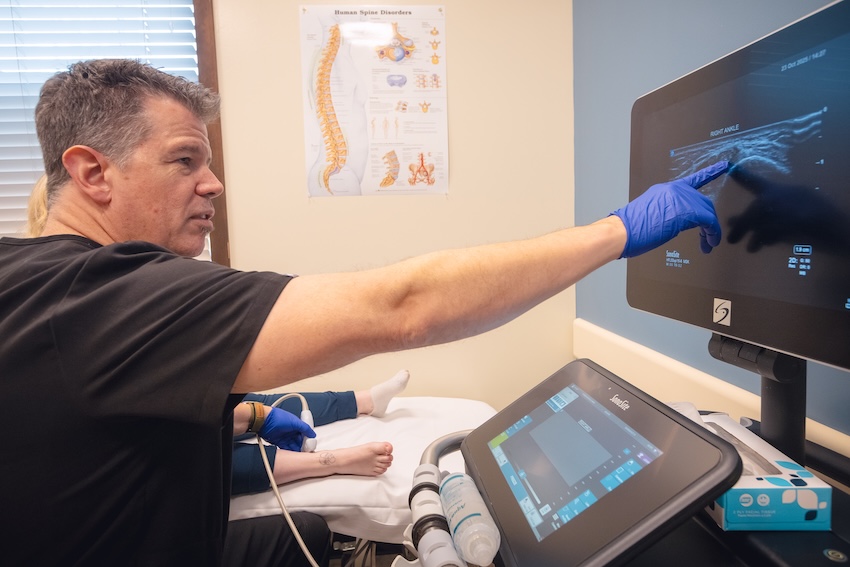
- Treatment planning: Your physician determines which modality — focused, radial, or a combination — is most appropriate, as well as the target site and treatment parameters. When musculoskeletal ultrasound is useful for identifying the target tissue, it may be used to guide treatment placement.
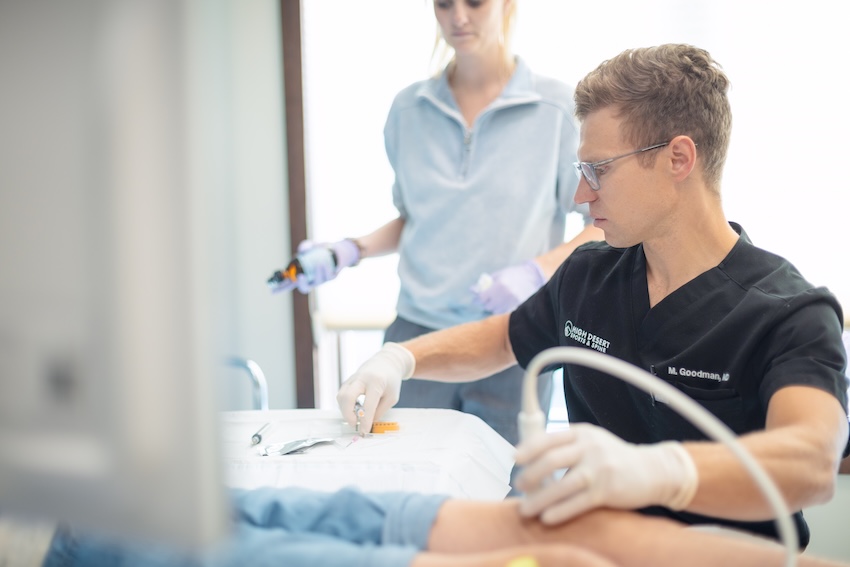
- Preparation: A coupling gel is applied to the treatment area. You’ll be positioned to allow comfortable access to the site. No anesthesia is required, though some discomfort during treatment is expected — particularly as the shockwave identifies and targets the most symptomatic area.
- Treatment: Each session typically takes 7 to 15 minutes. A handheld probe delivers the acoustic waves to the target tissue. Most patients tolerate the procedure well. Mild to moderate discomfort during treatment is common and is part of the normal process.
- Post-treatment guidance: You’ll receive specific instructions on activity, what to expect in the days following treatment, and any modifications — including whether to hold anti-inflammatory medications. Most patients can return to daily activities the same day.
- Follow-up: A full course of treatment typically consists of 3 to 5 weekly sessions. If PRP is part of your treatment plan, shockwave is ideally performed on the day of the PRP procedure and then resumed two weeks later. Tissue healing unfolds over weeks to months — follow-up appointments let us track your progress and adjust the plan as needed.
Each session runs about 15 to 30 minutes from start to finish, including setup.




Why Choose High Desert Sports & Spine for Shockwave Therapy in Bend, Oregon?
Several providers in Bend offer shockwave therapy — PT clinics, wellness centers, and Chiropractic practices. Here’s what’s different about our approach, and why it matters for your care.
Physician-Directed Treatment
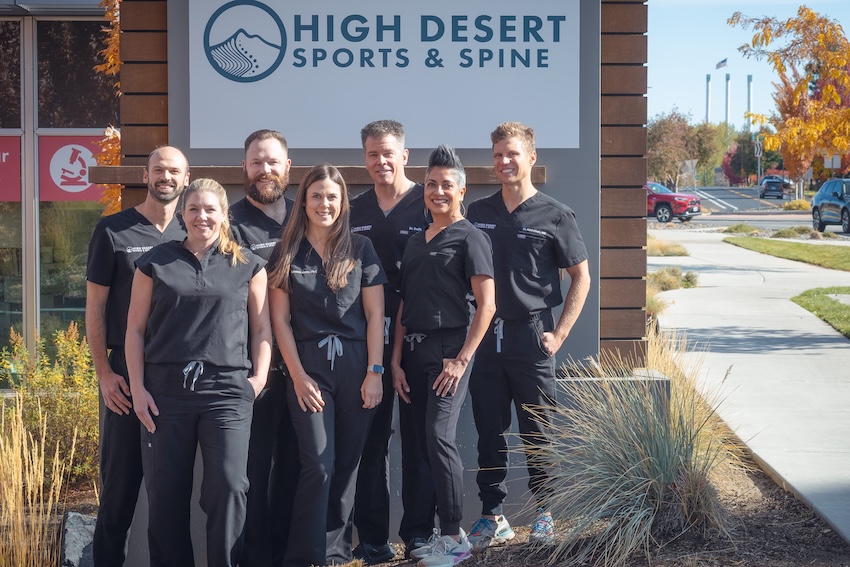
Shockwave therapy at High Desert Sports & Spine is evaluated, planned, and directed by board-certified, fellowship-trained physicians who specialize in musculoskeletal and orthopedic medicine. That’s a meaningful distinction. When shockwave is administered without physician oversight, there’s no clinical framework for determining whether it’s the right treatment, what parameters are appropriate, or how it fits into a broader plan.
Our physicians have the training and clinical background to assess your condition accurately, recommend shockwave when it’s indicated, and coordinate it with other treatments — including PRP, targeted injections, or rehabilitation — when a combination approach makes more sense.
Both Focused and Radial Modalities Available
HDSS offers both focused shockwave (ESWT) and radial shockwave (EPAT). We use both radial and focused modalities for most treatments, targeting a specific response for each. Many providers offering ‘shockwave therapy’ offer only one modality, typically radial, which is lower energy and easier to operate. Focused shockwave requires more specialized equipment and clinical skill, but it’s the right tool for deeper structures, calcific deposits, and bone-related conditions. Having both available means your treatment can be matched to your anatomy and diagnosis, rather than being limited by what the clinic happens to have.
Musculoskeletal Ultrasound, When It Helps
When musculoskeletal ultrasound is useful for visualizing the target tissue or confirming treatment placement, our physicians use it. This is not standard practice at most shockwave providers. For certain conditions — particularly calcific tendinopathies or cases where imaging helps confirm the anatomy — ultrasound guidance improves targeting accuracy.
Integrated Into a Comprehensive Treatment Approach
We’re not a standalone shockwave clinic. HDSS is a physician-owned orthopedic and sports medicine practice, and shockwave therapy is one tool within a broader treatment framework. If shockwave is the right call, we’ll recommend it. If PRP is more appropriate, or if a combination of both is indicated, we’ll build a plan based on what’s right for your case. If something else entirely is the better path, we’ll tell you that.
We coordinate closely with physical therapists, orthopedic surgeons, and primary care providers across Central Oregon. If your condition requires care we don’t offer, we’ll make sure you get to the right place.
Same-Week Access
New patient appointments for evaluations are typically available within a week, without month-long waits. We serve patients throughout Central Oregon, including Bend, Redmond, Sisters, Prineville, La Pine, and Sunriver.
Frequently Asked Questions About Shockwave Therapy in Bend, Oregon
Shockwave therapy delivers focused acoustic energy to a targeted area of damaged or degenerated tissue. The mechanical stimulus triggers a biological healing response — stimulating new blood vessel formation, breaking down calcific deposits, interrupting pain signals, and activating the body’s tissue repair mechanisms. It’s used for chronic orthopedic conditions where the tissue hasn’t healed well on its own.
The mechanism of action is based on shockwaves interrupting pain pathways of the inflamed nerves at cellular levels. This leads to restoration of healthy nerve function and promotes new blood vessel growth to facilitate natural healing.
A typical course of treatment is 3 to 6 weekly sessions. The exact number depends on your condition, the area being treated, and how your body responds. Your physician will outline a treatment plan based on your evaluation. If shockwave is being combined with PRP, the protocol timing changes — shockwave is typically performed on the day of PRP and then resumed two weeks later.
One of the main benefits of ESWT is the low risk. The treatment “extracorporeal,” meaning that patients receive the therapy “outside the body” instead of invasive surgery. Depending on the diagnosis patients may experience mild temporary discomfort during treatment as ESWT seeks out painful regions to desensitize them. The shockwaves are directed at the point of maximum symptoms to optimize healing.
Rarely ESWT may cause skin redness, bruising, numbness, tingling or radiating pain. If these symptoms do occur, they are short lived and self resolving. Contraindications to shockwave therapy include bleeding disorders and pregnancy.
Focused shockwave (ESWT) generates high-energy waves that converge at a specific depth within the tissue — it’s considered true shockwave therapy and is best suited for deeper structures, bone conditions, and calcific tendinopathies. Radial shockwave (EPAT) generates lower-energy pressure waves that spread outward from the applicator and are better suited for more superficial tissue and muscle-based conditions. HDSS offers both, and a combination approach is often used when treating different tissue depths within the same condition.
Shockwave therapy is most commonly used for chronic tendon conditions, including plantar fasciitis, Achilles tendinopathy, patellar tendinopathy, rotator cuff tendinitis, lateral epicondylitis (tennis elbow), and hamstring tendinopathy. It’s also used for calcific deposits in tendons, greater trochanteric pain syndrome, bone stress injuries, and myofascial pain. The research is strongest for plantar fasciitis and tendinopathies of the elbow and shoulder. A physician evaluation is required to determine whether shockwave is appropriate for your specific condition.
Some discomfort during treatment is expected and is a normal part of the process. The treatment is designed to target the most symptomatic area, so patients often experience mild to moderate sensations during the procedure. Most find it tolerable. Any soreness or mild swelling after treatment typically resolves within a few days. Each session runs about 7 to 15 minutes.
For most patients, there’s no required downtime. You can return to daily activities the same day. Depending on your condition and the area treated, your physician may recommend modifying certain activities for a short period following treatment. You’ll receive specific guidance at your appointment. One important note: anti-inflammatory medications (including NSAIDs like ibuprofen) are typically avoided around the time of treatment, as the inflammatory response shockwave triggers are part of how it promotes healing.
We do not bill insurance for any Shockwave Therapy (ESWT) or laser treatments.
Cortisone is a corticosteroid that works primarily as an anti-inflammatory — it provides relatively fast symptom relief by reducing inflammation at the injection site. Shockwave therapy works differently: it aims to stimulate a healing response through biological mechanisms, potentially addressing the underlying tissue condition rather than suppressing symptoms. For some patients and conditions, shockwave may offer more durable benefits. For others — particularly when fast relief is the priority or as a short-term bridge — cortisone may still be the more appropriate option. We’ll help you understand which makes sense for your situation.
Yes. Combining shockwave with platelet-rich plasma (PRP) is a common and well-studied combination for certain tendon conditions. The two treatments work through different mechanisms and can have a synergistic effect when timed correctly. When this approach is appropriate, shockwave is typically performed on the day of the PRP procedure, then resumed two weeks later to avoid disrupting the early healing response. Your physician will determine whether a combination approach makes sense for your condition.
No referral is required. You can contact our office directly to schedule a consultation and evaluation. Our team will help guide you toward the right next step.
- “Shock Waves In The Treatment of Stress Fractures.”
- “Extracorporeal Shock Wave Therapy Accelerates Regeneration After Acute Skeletal Muscle Injury.”
- “Extracorporeal Shock Wave Therapy is Effective in the Treatment of Bone Marrow Edema of the Medical Compartment of the Knee: A Comparative Study.”
- “Extracorporeal Shock Wave Therapy in the Treatment of Primary Bone Marrow Edema Syndrome of the Knee: A Prospective Randomised Controlled Study.”
- Extracorporeal shock wave treatment can normalize painful bone marrow edema in knee osteoarthritis: A comparative historical cohort study.
Shockwave Therapy in Bend, Oregon — Start With an Evaluation
If you’re exploring shockwave therapy in Bend, Oregon, and want an honest assessment from fellowship-trained orthopedic physicians, High Desert Sports & Spine is here to help.
We’ll start with a thorough evaluation, give you a clear picture of whether shockwave therapy is appropriate for your condition, and walk you through the options without pressure. If Shockwave is the right tool, we’ll explain exactly what to expect. If something else makes more sense, we’ll tell you that too.
Same-week appointments are typically available for new patients. We serve Bend, Redmond, Sisters, Prineville, La Pine, Sunriver, and patients throughout Central Oregon.