
Elbow Pain Treatment in Bend, Oregon
At High Desert Sports & Spine, our fellowship-trained, board-certified physicians evaluate and treat elbow pain in Bend, Oregon, with a focus on non-operative and interventional options.
Elbow pain has a way of becoming the thing you plan your day around. You stop shaking hands. You lift the coffee pot with the other arm. You quietly drop the parts of your sport that hurt and tell yourself it will settle down.
Sometimes it does. Often it doesn’t, because most elbow tendon pain is a degeneration problem rather than an inflammation problem. Rest and anti-inflammatories target inflammation. That mismatch is why so many people spend a year cycling through braces, ice, and cortisone without getting anywhere.
At High Desert Sports & Spine, our fellowship-trained, board-certified physicians evaluate elbow pain in Bend, Oregon, with in-office ultrasound and treat it with interventional and minimally invasive options. We look at the tendon directly, confirm what is actually damaged, and build a plan around what your tissue needs.
Same-week appointments are usually available for new patients.


When Elbow Pain Needs a Specialist
Most elbow pain from a single overload settles within a few weeks. The cases worth having looked at are the ones that don’t follow that pattern.
Consider a specialty evaluation if you’re dealing with:
- Elbow pain that has lasted longer than 6 weeks without improving
- Pain with gripping, lifting a coffee cup, shaking hands, or turning a doorknob
- Numbness or tingling in your ring and little fingers
- Pain that returned after a cortisone injection helped for a while
- A visible lump or swelling at the point of the elbow
- Weakness in your grip or forearm
- A sudden pop or tearing sensation during lifting, followed by bruising
- Elbow pain that keeps you from your sport or your work
A sudden pop with bruising and visible change in the muscle contour deserves prompt evaluation. Complete distal biceps tendon ruptures are time-sensitive and usually require surgical repair.
Elbow Conditions We Evaluate and Treat in Bend, OR
Tennis Elbow (Lateral Epicondylitis)
Tennis elbow causes pain on the outside of the elbow, usually right over the bony bump, and it often radiates into the forearm. Gripping makes it worse. So does lifting anything with your palm down, which is why people notice it first with a coffee mug or a milk jug.
Most people who get it have never played tennis. It shows up in climbers, mountain bikers, carpenters, hairstylists, mechanics, and anyone who spends the day on a keyboard and mouse.
Here is the part that changes how it should be treated. Despite the “itis” in epicondylitis, the tissue under a microscope shows degeneration and disorganized collagen rather than active inflammation. The tendon has broken down and hasn’t rebuilt itself. That matters because treatments aimed at reducing inflammation target something that largely isn’t there. That explains why many patients get partial, temporary relief and then end up back where they started.
We evaluate the common extensor tendon with ultrasound to see how much of it is involved and whether there is any tearing. Depending on what we find, options may include ultrasound-guided injection, PRP, shockwave therapy, or percutaneous tenotomy for chronic tendon changes. Load management and targeted strengthening run alongside whatever we do, because the tendon has to be rebuilt, not just quieted.
Golfer’s Elbow (Medial Epicondylitis)
Golfer’s elbow is the same problem on the inside of the elbow, affecting the flexor and pronator tendons instead of the extensors. Pain occurs with gripping, wrist flexion, and forearm rotation. Weightlifters, throwers, climbers, and golfers all see it.
It responds to the same category of treatment as tennis elbow, though the anatomy nearby is more crowded. The ulnar nerve runs right behind the medial epicondyle, and medial elbow pain can involve both the tendon and the nerve. Ultrasound guidance matters here for a practical reason: it keeps the needle where it belongs and away from where it doesn’t.
Ulnar Collateral Ligament (UCL) Injuries in Throwing Athletes
The ulnar collateral ligament is the main stabilizer on the inside of the elbow. Every overhead throw puts it under heavy load, and over hundreds of repetitions that load can stretch, fray, or tear it. Baseball pitchers are the classic example, but we also see UCL injuries in softball players, javelin throwers, quarterbacks, volleyball players, and tennis players with a heavy serve.
The usual complaint is pain on the inside of the elbow as the arm comes forward to release the ball, along with a drop in velocity or control. Some athletes feel a distinct pop. Because the ulnar nerve runs right alongside the ligament, tingling in the ring and little fingers can also show up.
Ultrasound is especially useful here. We can image the ligament directly and perform a dynamic stress test, applying a controlled load to the elbow while measuring how much the inner joint opens compared to your other arm. That gives a functional picture of the ligament that a static MRI does not, and because it can be repeated at follow-up visits, it lets us track healing rather than guess at it.
Treatment depends on the grade of injury and what you want to get back to. Partial tears are typically managed with a period away from throwing, a structured rehabilitation and return-to-throw program, and for many athletes, ultrasound-guided PRP. Research on PRP for partial UCL tears in throwers has been encouraging, and it is one of the more compelling applications of PRP in sports medicine. Complete tears, or partial tears that do not respond in an athlete who wants to keep throwing at a high level, may need surgical repair or reconstruction, commonly called Tommy John surgery. We will tell you honestly which category you are in and coordinate with surgeons who specialize in throwing athletes when surgery is the right path.
Throwing mechanics and workload matter as much as the ligament itself. Part of every UCL plan is looking at what loaded the elbow past its limit, because returning to the same pattern tends to produce the same injury.
Cubital Tunnel Syndrome (Ulnar Nerve Entrapment)
Cubital tunnel syndrome happens when the ulnar nerve gets compressed or tethered as it passes behind the inside of the elbow. Numbness and tingling in the ring and little fingers, often worse when your elbow is bent, so people notice it while sleeping, driving, or holding a phone. Left long enough, it can progress to grip weakness and loss of fine coordination.
We can see the ulnar nerve on ultrasound and assess whether it is enlarged, tethered to surrounding tissue, or subluxing over the bone when you bend your elbow. For appropriate patients with mild to moderate symptoms, ultrasound-guided hydrodissection uses precisely placed fluid to separate the nerve from the tissue restricting it and restore its ability to glide.
Advanced compression with muscle wasting, constant numbness, or significant findings on nerve testing needs surgical evaluation. We will tell you clearly if you are in that category and coordinate the referral.
Conditions That Mimic Tennis Elbow
This deserves its own section because it is one of the most common reasons elbow treatment fails.
The radial nerve runs through a tissue plane on the outside of the elbow and needs to glide freely as the arm moves. When it gets stuck to the surrounding tissue, it produces pain that sits in almost exactly the same place as tennis elbow. If you treat it as tennis elbow, it won’t improve because the tendon wasn’t the problem.
Damage in the forearm muscle belly, rather than at the tendon attachment, is another. So is referred pain from the neck, which is easy to miss if nobody examines the cervical spine.
Ultrasound lets us look at the tendon, nerve, and muscle in the same visit and sort out what is driving your symptoms. When a nerve is the culprit, hydrodissection is a targeted option rather than another round of treatment aimed at the wrong tissue.
Distal Biceps and Triceps Tendonitis
The distal biceps tendon attaches at the front of the elbow and the triceps tendon at the back. Both can develop tendonitis and partial tearing from repetitive pulling, pushing, and heavy lifting. Pain at the front of the elbow with curling or lifting palm-up, or pain at the back with pressing and extension.
These can respond to ultrasound-guided injection, PRP, and shockwave therapy, depending on the extent of tendon change. A complete rupture is a different situation and is generally repaired surgically, usually sooner rather than later, so prompt evaluation matters if you felt a distinct pop.
Olecranon Bursitis
The olecranon bursa sits over the point of the elbow and can swell after a direct blow, a fall, or prolonged leaning on hard surfaces. Sometimes it looks dramatic and isn’t especially painful. Sometimes it is both.
Most cases settle with padding, activity changes, and compression. When swelling persists or limits motion, ultrasound-guided aspiration can drain the bursa and confirm its contents. Any bursitis with redness, warmth, and fever needs prompt evaluation to rule out infection, which is managed differently.
Elbow Arthritis
Elbow arthritis is less common than knee or hip arthritis, but it happens, particularly after old fractures, dislocations, or years of heavy loading. Stiffness, aching, grinding, and gradual loss of full extension are typical. Losing the last few degrees of straightening is often the first thing people notice.
Image-guided joint injection can provide meaningful relief, and for select patients with early to moderate changes, orthobiologic options may be worth discussing. We will be straightforward about what these can and cannot do for an arthritic joint.
Overuse and Repetitive Strain
Central Oregon loads elbows hard. Climbing, mountain biking, paddling, Nordic skiing, and CrossFit all involve repeated gripping and pulling. So does trades work, and so does forty hours a week on a mouse.
Overuse problems build slowly, which is why patients usually can’t name the day it started. We look at load, mechanics, tissue quality, and what prevents recovery between sessions, because treating the tendon without changing what irritates it usually buys time rather than providing a solution.
Overuse elbow pain can look similar in the early stages, but it falls into three categories that need very different handling. Getting the category wrong can go badly in both directions: resting a tendon that needs progressive loading, or continuing to load a bone that is starting to crack.
Tendonitis and tendinopathy. Pain that builds gradually over the bony points on the outside or inside of the elbow, worse with gripping and lifting, and often easing a bit once you warm up. Central Oregon produces plenty of it: climbers, mountain bikers, paddlers, Nordic skiers, trades workers, and anyone spending long hours on a mouse. These are the tendon problems covered in the tennis elbow and golfer’s elbow sections above.
Thrower’s elbow. An umbrella term for the injuries caused by the repeated force of overhead throwing, which stresses the inside of the elbow, compresses the outside, and jams the back of the elbow into its socket at the end of each throw. That can mean UCL stress, ulnar nerve irritation, bone spurs, loose fragments in the joint, or impingement at the back of the elbow. Common signs include pain at ball release, pain at the back of the elbow, and a gradual loss of the ability to fully straighten the arm.
Stress fracture. Bone can fail under repetitive load just as tendons can. In throwers, the olecranon (the bony point at the back of the elbow) is a common site. Watch for pain that steadily worsens rather than plateauing, tenderness over one specific spot on the bone, and pain that lingers at rest or at night. Early X-rays are often normal, so a stress fracture can be missed if no one is looking for it. These need a real break from throwing, and some need surgical fixation.
We determine your category through the exam, in-office ultrasound, on-site X-ray, and MRI when the picture calls for it. The answer determines whether the plan is loading, rest, a procedure, or a referral.
Acute Elbow Injuries and Non-Displaced Fractures
A fall on an outstretched hand, a bike crash, or a direct impact can cause a fracture, dislocation, or ligament injury. Radial head fractures are common and frequently non-displaced, which means they usually do not need surgery, but they do need accurate diagnosis and appropriate early motion to avoid stiffness.
We have on-site X-ray and can evaluate, immobilize, and manage non-displaced fractures in-house. We coordinate displaced or unstable injuries directly with orthopedic surgeons in Central Oregon.
For an acute elbow injury, our Orthopedic Urgent Care offers same-day or next-day evaluation without the ER wait.
Elbow Injuries in Children and Adolescents
A young athlete’s elbow is not a smaller version of an adult’s. Until the growth plates close in the mid to late teens, they are weaker than the ligaments and tendons attached to them. The same forces that would strain a ligament in an adult tend to injure a child’s growth plate, which changes both the diagnosis and the treatment.
Little League elbow (medial epicondyle apophysitis). Repeated throwing stresses the growth plate on the inside of the elbow. It causes pain on the inner elbow, sometimes swelling, and a drop in throwing performance. Most cases heal with rest from throwing followed by a gradual return, but if throwing continues through the pain, it can progress to a fracture through the growth plate.
Osteochondritis dissecans (OCD). An area of bone and cartilage on the outside of the elbow loses its blood supply and begins to soften or separate. It tends to appear in early adolescence in throwers and gymnasts. Watch for pain on the outer elbow, catching or locking, and loss of the ability to fully straighten the arm. OCD is the condition in this group we most want to see early, because early lesions often heal with rest while advanced ones may need surgery.
Acute fractures. Falls on an outstretched arm are the most common cause of elbow fractures in children, and some involve the growth plate. Evaluate any elbow injury in a child with significant swelling, visible deformity, or reluctance to move the arm the same day.
For parents and coaches: elbow pain in a young thrower is not normal and should not be played through. Following age-based pitch count and rest guidelines, such as those published through Pitch Smart by USA Baseball and Major League Baseball, avoiding pitching on consecutive days, and building in real-time off from throwing each year are the most effective ways to prevent these injuries. When a young athlete does get hurt, we work with families and coaches on a structured return-to-throw progression rather than a guess.


How We Diagnose Elbow Pain
Elbow pain is one of those problems where the diagnosis does most of the work. Tendon, nerve, joint, and referred neck pain all produce overlapping symptoms in a small area.
A typical evaluation includes:
- History and symptom review. When it started, what aggravates it, what you have already tried, and what you are trying to get back to.
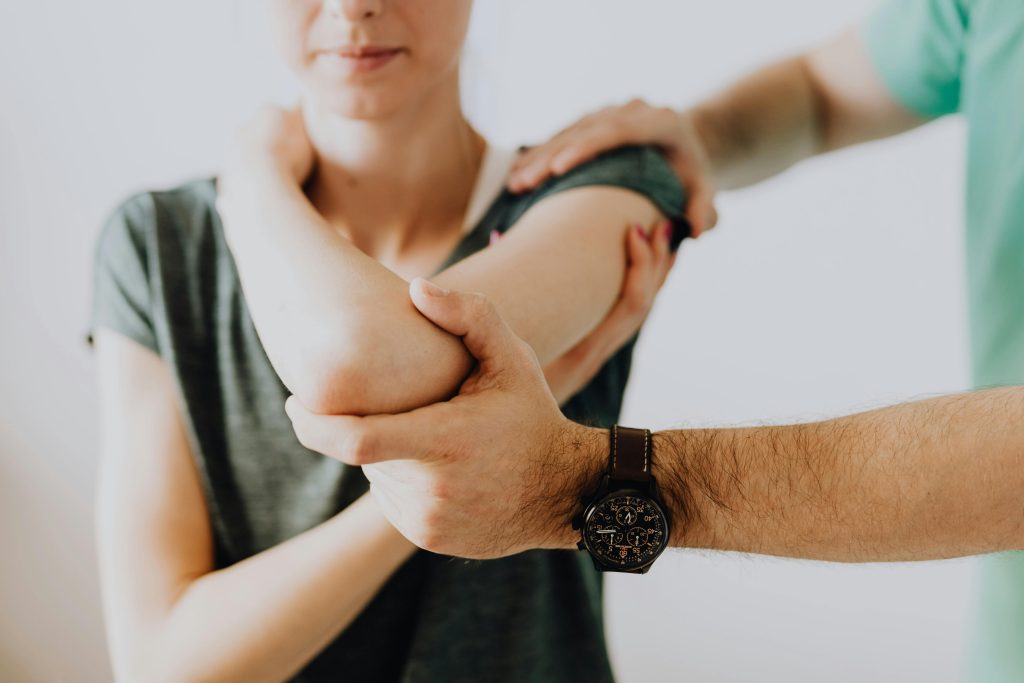
- Physical examination. Range of motion, grip strength, nerve function, ligament stability, and provocative testing that helps separate tendon from nerve from joint. We also examine the neck and shoulder because elbow pain doesn’t always come from the elbow.
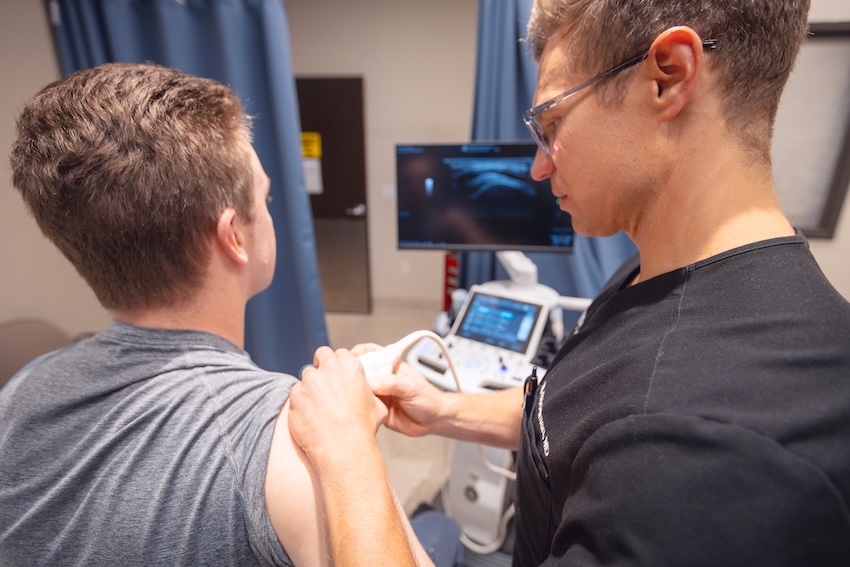
- In-office musculoskeletal ultrasound. We look at the common extensor and flexor tendons, the biceps and triceps insertions, the ulnar and radial nerves, and the joint itself in real time. Ultrasound also lets us assess the nerve dynamically while you bend and straighten your arm, which a static scan cannot do.
- On-site X-ray. Available at the same visit when we need to evaluate bone, joint space, or a suspected fracture.
- Electrodiagnostic testing. Nerve conduction studies or EMG can confirm the location and severity of nerve compression when the clinical picture calls for it.
- MRI referral. Arranged when a clearer structural picture is needed, particularly for suspected ligament injury or a significant tendon tear.
You will leave understanding what is causing your pain, what your options are, and what we recommend along with the reasoning behind it.
Treatment Options for Elbow Pain at HDSS
Your plan depends on which structure is involved, how long it has been going on, and what you are trying to get back to. Nothing here is applied automatically.
Ultrasound-Guided Injections
Every injection at HDSS is performed under real-time ultrasound. At the elbow, targets sit close to nerves and vessels, and accuracy matters for both effectiveness and safety. Corticosteroids still have a role, particularly for an acute flare that needs to settle before rehabilitation can start. To be honest, repeated cortisone injections into a degenerated tendon are not a good long-term plan, and research on tendon quality after repeat injections is a reason to be selective.
PRP Therapy
Platelet-rich plasma uses a concentrated portion of your own blood, delivered into the damaged tendon under ultrasound guidance. Chronic tendon degeneration is the clearest application for PRP in orthopedic care, and the elbow is one of the better-studied sites. Results develop over weeks to months rather than immediately.
Shockwave Therapy (ESWT)
Acoustic energy is delivered to chronic tendon tissue to stimulate a healing response. HDSS offers both focused and radial shockwave, letting us match the modality to the target depth. For chronic epicondylitis, the evidence base is solid, and the treatment requires no downtime.
Percutaneous Tenotomy
For tendons with established degeneration, a small ultrasound-guided needle breaks up the disorganized tissue and prompts a healing response. This is an in-office option for patients whose tendon changes have not responded to less invasive care and who want something short of open surgery.
Nerve Hydrodissection
A precisely placed injection of fluid separates a compressed or tethered nerve from the tissue restricting it. At the elbow, this applies to the ulnar nerve in cubital tunnel syndrome, the radial nerve in cases that mimic tennis elbow, and nerve adhesions after prior surgery.
MLS Laser Therapy
Non-invasive light therapy to reduce inflammation and support tissue recovery. Useful as an adjunct alongside other treatment or for patients who want an active option without needles.
Bracing and Load Management
A counterforce brace, a change in grip size, or an adjustment to how you are loading the arm can matter more than any injection. We will say so when that is the case.
Coordination of Care
Complete tendon ruptures, advanced nerve compression with muscle wasting, and unstable fractures need surgical evaluation. We coordinate directly with orthopedic surgeons in Central Oregon rather than leaving you to sort out the referral.




Who May Benefit from Specialty Elbow Care
An evaluation at High Desert Sports & Spine may be worth considering if you:
- Have had tennis elbow or golfer’s elbow for more than a couple of months without real improvement
- Got temporary relief from a cortisone injection and watched the pain come back
- Have been told to rest and wait, and have already done that
- Have numbness or tingling in your ring and little fingers
- Have elbow pain that is changing how you train, work, or play
- Have been told surgery is the next step and want to understand what comes before it
- Have pain that persisted after previous elbow surgery
- Need prompt evaluation of an acute elbow injury
If your symptoms are recent, mild, and already improving, load management and time are still a reasonable first approach. We will tell you if that applies to you.
Why Choose High Desert Sports & Spine for Elbow Pain in Bend, OR?
Fellowship-Trained, Board-Certified Physicians
Our physicians completed fellowship training in sports medicine, musculoskeletal medicine, or interventional spine care after medical school and residency. Most tennis elbow care in Bend comes from rehabilitation providers. Rehabilitation is a real and necessary part of tendon recovery, and we work with excellent therapists across Central Oregon. What it does not include is diagnostic imaging, injection, or interventional treatment when rehabilitation alone has not been enough.
We Look at the Tendon Before We Treat It
In-office ultrasound lets us see how much of the tendon is involved, whether there is tearing, and whether a nerve is contributing. Elbow pain is treated blind more often than it should be, and a meaningful share of stubborn “tennis elbow” turns out to be something else.
The Full Range of Interventional Options in One Place
Ultrasound-guided injection, PRP, focused and radial shockwave, percutaneous tenotomy, nerve hydrodissection, and MLS laser are all available in-office. You won’t chase referrals to access them, and the physician evaluating you will perform the treatment.
We Will Tell You When Surgery Is the Answer
A complete distal biceps rupture needs a surgeon, and quickly. So does advanced ulnar nerve compression with muscle wasting. Our job is to make sure the non-operative options were considered properly, and to say plainly when they have been exhausted or when they were never the right path.
Same-Week Access
New patient appointments are typically available within a week. For acute elbow injuries, our Orthopedic Urgent Care offers same-day or next-day evaluation. We serve Bend, Redmond, Sisters, Prineville, La Pine, and Sunriver.


What to Expect at Your Elbow Evaluation
- Specialty evaluation. History, prior treatment, any imaging you already have, and what you are trying to get back to.
- Hands-on exam and in-office imaging. Physical examination plus ultrasound or X-ray as indicated, during the same visit.
- Clear diagnosis and options. You will understand which structure is involved, which treatments apply, and what realistic timelines look like. Tendon healing takes time, and we will be straight with you about that.
- A plan you agree with. If treatment is recommended, we outline it and schedule it. No pressure and no upsell.
- Follow-up. We track your response and adjust. Most tendon plans involve at least one follow-up to check progress.
Elbow Pain Treatment in Bend, Oregon: Schedule an Evaluation
If elbow pain has outlasted rest, bracing, and a cortisone injection, the next step is finding out what is actually wrong with the tissue.
We will examine you thoroughly, use ultrasound to look at the tendon and the nerve, and walk through your options without pressure.
Same-week appointments are typically available for new patients. We serve Bend, Redmond, Sisters, Prineville, La Pine, Sunriver, and patients throughout Central Oregon.
Frequently Asked Questions About Elbow Pain in Bend, Oregon
Usually one of three reasons. First, tennis elbow is a tendon degeneration problem rather than an inflammation problem, so rest and anti-inflammatories target the wrong issue. The second is that the tendon needs progressive loading to rebuild, and complete rest can make it weaken further. Third, it may not be tennis elbow at all. Radial nerve entrapment, forearm muscle damage, and referred pain from the neck all produce pain in the same area and do not respond to tennis elbow treatment. An ultrasound evaluation can help determine which situation you have.
Location and which tendons are involved. Tennis elbow affects the extensor tendons on the outside of the elbow and hurts with gripping and lifting with your palm down. Golfer’s elbow affects the flexor and pronator tendons on the inside and hurts with wrist flexion and forearm rotation. Both are degenerative tendon conditions, and both respond to similar treatments. Neither requires playing the sport it is named after.
Cortisone typically provides good short-term relief, and there are situations where that is useful, particularly when an acute flare needs to settle enough for you to start rehabilitation. The concern is the longer horizon. Research comparing corticosteroid injection with orthobiologic and energy-based treatments for chronic lateral epicondylitis generally finds corticosteroids perform well early and then decline, with symptom recurrence common. Evidence also suggests repeated corticosteroid injections can affect tendon quality over time. We use it selectively and will explain the tradeoff before you decide.
It varies considerably. A recent case caught early and managed with load modification and progressive strengthening may settle in a couple of months. Chronic cases that have been building for a year or more take longer and often need something that restarts the healing process, such as PRP, shockwave, or percutaneous tenotomy. Tendon remodeling is measured in months, not weeks, regardless of the treatment used. We will set realistic expectations based on what your ultrasound actually shows.
Most people do not. Surgical release is generally reserved for cases that have failed a thorough course of non-operative treatment, and a genuinely thorough course includes more than rest, bracing, and a cortisone injection. Interventional options such as PRP, shockwave, and percutaneous tenotomy sit between conservative care and surgery, and many patients never hear about them. If surgery turns out to be the right call for you, we will say so and coordinate the referral.
Chronic tendon degeneration is one of the clearest applications for PRP in orthopedic care, and the elbow is among the better-studied sites. It is most relevant for tendinopathy that has persisted despite conservative care. Results build gradually over weeks to months rather than immediately. Whether you are a reasonable candidate depends on what the ultrasound shows and how long you have had the problem, which is what the evaluation is for.
Health insurance does not cover PRP, so it is an out-of-pocket expense. Coverage varies by payer and continues to evolve. Contact your insurer directly for current information on your plan. Our team can discuss self-pay options during your consultation, and some patients use HSA or FSA funds.
That distribution follows the ulnar nerve, and the most common cause is compression at the elbow, known as cubital tunnel syndrome. Symptoms are usually worse with the elbow bent, so people notice them while sleeping, driving, or holding a phone. It is worth evaluating rather than waiting, because prolonged compression can lead to grip weakness and muscle loss that does not fully recover.
Yes, and we see a lot of it. Repeated gripping and pulling loads the elbow tendons hard, and climbers in particular develop both lateral and medial elbow tendinopathy. Treatment involves addressing the tendon and also looking at load, grip, and training volume, since returning to the same pattern that caused it often brings it back.
No referral is required. Contact our office directly to schedule an evaluation. If you have prior imaging or nerve testing, bring it. It helps us make the most of your first visit.